
Climate Change is Colonial VIolence: a Primer


Climate change is colonial violence.
This is not a new opinion. Activists, researchers, and Indigenous peoples around the world have been declaring for decades the ways in which climate change is both caused by and perpetuates colonialism. Yet the public discourse surrounding climate change in Western countries often lacks this decolonial perspective. Instead, it focuses on either doom-and-gloom “humans are the virus” narratives or on eerily cheerful stories of how technology will save us all. So what can we do to flip the narrative, to recenter the colonial violence inherent in climate change around the world?
COLONIALISM AS: CAUSE OF CLIMATE CHANGE

Māori land in Te Ika-a-Māui (the North Island), 1860–1939 & Forest cover of Aotearoa (New Zealand), 1840-present day (Images Source: Decolonial Atlas)
It’s generally common knowledge these days that the burning of fossil fuels is one of, if not the primary, cause of climate change. Yet we must ask, why and how did the use of fossil fuels proliferate? The answer, I would argue, is the colonial countries' obsession with environmental and capitalistic control. This control aims for the destruction of other ways of life all around the globe, to be replaced with a growing dependence on fossil fuels—a dependence that isn’t just a money-making scheme, but also an inherently colonial enterprise on the part of those in power.
The evidence is everywhere once you start looking. In India, British colonial rule systematically dismantled local textile industries and forest stewardship practices, replacing subsistence economies with extraction-based ones geared toward export. In the Congo, Belgian colonizers violently enforced rubber quotas, stripping vast stretches of rainforest to feed European industrial demand. Across the Caribbean, plantation agriculture razed diverse ecosystems and replaced them with sugar monocultures maintained by slave labor, all to sweeten the coffee cups of European cities running on coal.
Here it becomes clear that colonialism from the earliest days of its expansion led to massive deforestation, monocultures, and other forms of environmental devastation. Perhaps no case study illustrates this more vividly than Britain's coal economy and its relationship to colonial cotton production. The mills of Lancashire that drove the Industrial Revolution (and with it, the mass burning of coal) were fed by cotton grown on slave labor in the American South and colonial India. So, it’s clear that colonialism didn't just run alongside fossil fuel industrialization, it bankrolled it and accelerated it. Or, to put it more bluntly, the profits extracted from colonized peoples and lands were reinvested into the very infrastructure (railways, shipping lines, factories, etc.) that locked the global economy into carbon dependence for centuries to come.
At the same time, colonial violence also manifested itself through cultural erasure. Suppressing Indigenous human-nature relationships and encouraging dominion over all nonhuman life instead enabled climate change to grow like cancer. The forced assimilation of Indigenous peoples into settler economies (through residential schools, land dispossession, and the criminalization of traditional practices) didn't just destroy cultures. It destroyed entire systems of ecological knowledge that had kept landscapes in balance for millennia.
When the Anishinaabe were removed from their wild rice territories, or when Aboriginal Australians were barred from conducting cultural burns, the land itself suffered. Replacing relational, reciprocal ways of living with extractive ones meant removing the very practices that had long acted as a brake on environmental destruction. As climate justice activist and lawyer Jameela Joy Reyes explains, “we now have a fossil fuel-dependent economy that intensifies social inequality, displaces vulnerable populations, erases indigenous knowledge systems, and reinforces global power imbalances, all of which contribute to the worsening climate crisis.”
COLONIALISM AS: DRIVER OF VULNERABILITY TO CLIMATE CHANGE
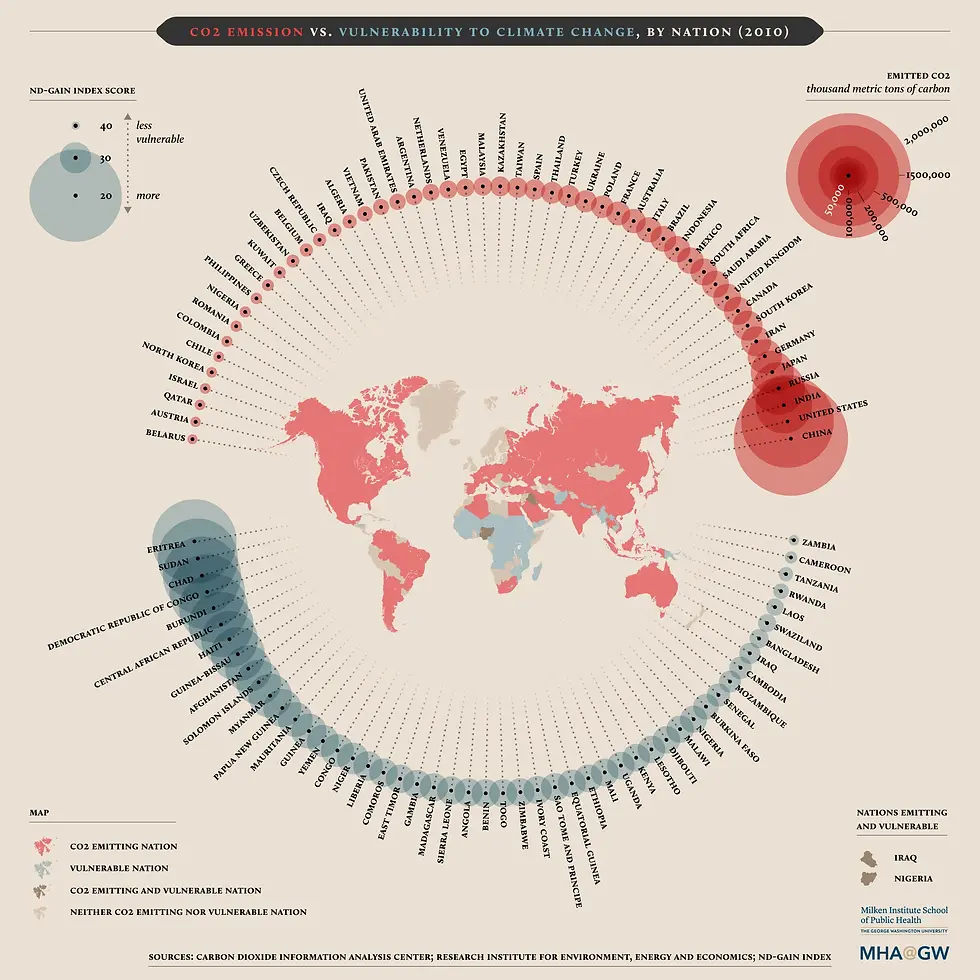
CO2 Emissions vs. Vulnerability to Climate Change, By Nation (2010)
(Image source: click for zoomable version)
In addition to being one of the causes of climate change as we know it today, colonialism has also impacted who is most affected by the climate crisis. In early 2022, the sixth Intergovernmental Panel on Climate Change (IPCC) released its final report, naming for the first time “historical and ongoing patterns of inequity such as colonialism” as a driver of vulnerability and exposure to the effects of climate change. As I wrote earlier, of course, Indigenous activists and scientists such as Kyle Whyte, Tom Goldtooth, and many others have already been claiming this for decades, if not longer (see also, the Kari-Oca 2 Declaration from 2012).
One of these “patterns of inequity” cited in the IPCC report is the global economic system, which continues to depend on fossil fuels and benefit countries and regions unequally. This is a system that is “shaped by centuries of colonial power and still locking lower-income countries into structural dependence.” This dependence is not accidental. Colonial powers historically structured their territories as exporters of raw materials and importers of manufactured goods, a relationship that persisted long after formal independence through debt obligations, trade agreements, and IMF structural adjustment programs.
Land regimes and the privatization of territory are another central mechanism through which colonialism drives climate vulnerability. Across Africa, Asia, and the Americas, colonizers dismantled communal land stewardship systems and replaced them with private property regimes. Where Indigenous and peasant communities had collectively managed forests, wetlands, and watersheds for generations—forming a living relationship with the land—privatization introduced incentives to extract, sell, and develop. In other words, land was transformed from that living relationship into a newly tradeable asset.
The consequences for climate vulnerability are direct: communities that once held collective rights to forests as flood buffers or to wetlands as water sources have found those ecosystems sold off and destroyed. In Bangladesh, for example, the privatization and conversion of coastal mangrove forests (many of which were communally managed before colonial land reforms) has stripped away natural protection from the cyclones and storm surges that climate change is making ever more intense.
Connected with this, and perhaps the most underappreciated driver of climate vulnerability, is the systematic marginalization of Indigenous and traditional ecological knowledge. For centuries, colonial administrations (and later development institutions) dismissed non-Western environmental knowledge as superstition or backwardness, replacing it with monoculture agriculture, concrete infrastructure, and resource extraction.
The Karuk Tribe of Northern California offers a powerful example of what is lost when this happens. The Karuk had for millennia used controlled burns to manage the forests of the Klamath River watershed—maintaining biodiversity, reducing wildfire risk, and supporting salmon populations. When the U.S. government banned these practices in the nineteenth and twentieth centuries, decades of unburnt fuel accumulated in the forest. The catastrophic wildfires now scorching California each summer are, in part, the result of suppressing Indigenous fire stewardship. Scientists and land managers are only now beginning to reinstate cultural burning, essentially rediscovering knowledge that was never lost, only forcibly silenced.
DE-COLONIALISM AS: CLIMATE JUSTICE
So, if colonialism has caused and perpetuated the climate crisis, then what might decolonial climate justice look like in the face of these historical injustices?
Firstly, many have argued that it is Indigenous voices that must lead the movement for climate justice. This is not simply a matter of representation. It is a matter of survival and of effectiveness. Indigenous peoples constitute less than five percent of the global population yet steward roughly 80% of the world's remaining biodiversity. Their governance systems, legal traditions, and relational frameworks carry knowledge refined over thousands of years. When Indigenous-led movements are given real power (not merely just a seat at the table) the results speak for themselves.
For example, the Standing Rock Sioux's resistance to the Dakota Access Pipeline galvanized a global movement and temporarily halted construction. In Canada, First Nations-led land protections have proven more effective at preserving ecosystems than state-managed conservation areas. Frameworks like the Red Deal, developed by Indigenous activists, go further still, arguing that genuine climate justice requires not just policy reform but the restoration of Indigenous sovereignty and the dismantling of the colonial systems that caused the crisis in the first place.
Secondly, there is a growing push for colonial nations to cancel debts and pay what is known as climate reparations. The logic is straightforward: the countries that did the most to cause climate change through colonial extraction and industrial carbon emissions are not the ones bearing the worst consequences. The nations of the Global Majority World (an alternative term for Global South proposed to flip implicit hierarchies in the terms we use)—many of them former colonies—face the most severe floods, droughts, and displacement, despite contributing the least to the problem. Climate reparations would mean wealthy nations not only providing financial support for adaptation and loss and damage, but acknowledging the historical debt owed. At the 2025 United Nations Climate Change Conference, more commonly known as COP30, advocates urged that climate finance be explicitly linked to reparations for colonial crimes, a framing that moves the conversation from charity to justice, from aid to accountability.
So, systemic change is needed urgently. Again, as Jameela Joy Reyes writes, “unless the approach to address the climate crisis includes steps towards systemic change, then the same forms of violence that have historically been part and parcel of the fossil economy will continue to perpetuate even as we try to create a fossil fuel-free world.” A green energy transition that builds solar farms on land stolen from Indigenous communities, or that finances adaptation through the same debt mechanisms used to enforce colonial dependence is not climate justice. It is colonialism in a new skin.
It’s been said again and again and again and again, but I’m here to say it once more, for it must be said. It must be shouted from rooftops, graffitied on the sides of private jets. Climate change is colonial violence.
It’s time to start imagining what decolonizing climate action could look like.
Further Reading:
Note: Please contact us for PDFs of any sources that are behind a paywall! We believe in free, accessible knowledge for all.


Comments